What does it take to build a talent pipeline that delivers today and prepares you for tomorrow? For many organisations, the answer gets muddled because they conflate performance with potential. Someone who’s brilliant in their current role gets promoted into leadership, only to struggle. Meanwhile, someone with genuine leadership potential gets overlooked because they’re not yet a top performer.
At Let’s Talk Talent, we believe that everyone has talent — but high performers and high potentials need different support to maximise their strategic impact. Understanding the distinction between these two groups, and knowing how to develop each effectively, is what separates organisations that thrive from those that plateau.
This guide introduces LTT’s three-group talent model and our 3 E’s framework — Experience, Exposure, Expertise — with practical steps you can take to develop both sides of your talent equation.
In this article, you’ll learn:
- The difference between high performers and high potentials
- LTT’s three-group talent model
- The 3 E’s framework for talent development
- How to develop high performers
- How to develop high potentials
- The role of HR, managers and organisations
- Common pitfalls to avoid
High Performers vs High Potentials: What’s the Difference?
High performers consistently deliver exceptional results in their current roles. They’re reliable, skilled and often set the standard for others. High potentials have the capacity and motivation to grow into larger or more complex roles in the future. They may not yet be top performers, but they show the learning agility, ambition and adaptability to step up.
Here’s the crucial distinction: Performance reflects what someone delivers today. Potential reflects what they could deliver tomorrow, given the right conditions.
Key differences include:
- Timeframe — High performers excel now; high potentials are being developed for future roles
- Focus — High performers drive current operational success; high potentials build leadership pipeline and future capability
- Typical behaviours — High performers demonstrate deep expertise and consistent delivery; high potentials show learning agility, curiosity and adaptability
- Motivation — High performers may or may not want leadership roles; high potentials actively seek growth and increased responsibility
- Risk if mismanaged — High performers can burn out or be mis-promoted into roles they don’t want; high potentials can become disengaged if development is neglected or leave for better opportunities elsewhere
Not all high performers are high potentials — and that’s perfectly fine. Some of your best people want to deepen their expertise rather than move into leadership. The key is to recognise the difference and create career pathways that work for both groups.
The Three Sides of Talent: Highly Regarded Specialists, Future Leaders and the Talented Many
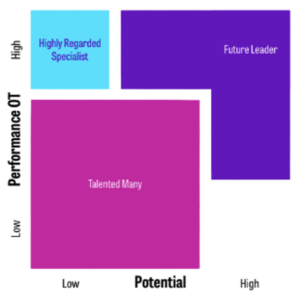
At LTT, we use a three-group model that goes beyond simplistic 9-box thinking. This approach recognises that talent exists across your organisation in different forms, and each group needs tailored support:
1. Highly Regarded Specialists (often your high performers)
Who they are: Experts who excel in their current roles, delivering consistent, high-quality results. They have deep technical or functional expertise and are often the people everyone turns to when things need to get done right.
What you risk if they’re not supported: Burnout from overwork, disengagement from lack of recognition, or losing them to competitors who value specialist expertise. You also risk mis-promoting them into leadership roles they don’t want or aren’t suited for.
Development focus: Deepen expertise, expand influence through mentoring and knowledge-sharing, provide stretch without moving them away from what they do best, and create specialist career tracks that reward excellence without requiring people management.
2. Future Leaders (your high potentials)
Who they are: Individuals with the ambition, adaptability and leadership traits to take on more complex responsibilities. They demonstrate strong learning agility, emotional intelligence and the drive to lead and create change.
What you risk if they’re not supported: They’ll leave for organisations that invest in their development. You’ll also end up with leadership gaps when senior people retire or move on, and you’ll struggle to execute strategy without people who can lead through complexity and change.
Development focus: Structured leadership experiences, exposure to senior leaders and strategic decisions, coaching and assessment to build self-awareness, and opportunities to lead projects and initiatives that build confidence and capability.
3. The Talented Many (broader potential across the organisation)
Who they are: Individuals across the organisation with untapped potential who, with the right support, can elevate their contribution. They may not be in a formal talent programme yet, but they show curiosity, commitment and capability.
What you risk if they’re not supported: You create a two-tier culture where only chosen people get development. You miss talent that doesn’t fit obvious patterns. You limit diversity in your leadership pipeline.
Development focus: Access to learning and development opportunities, managers who spot and nurture potential, clear career pathways that show what’s possible, and a culture where everyone can grow.
For more on how to map your workforce and build robust succession plans around these groups, download our Succession Planning Whitepaper.
LTT’s 3 E’s Talent Development Framework: Experience, Exposure, Expertise
In all the talent development work we do with our clients, we always come back to one pivotal question:
‘What Experience, Exposure and Expertise does this person need to thrive in their role today and prepare for the challenges of tomorrow?’
This question forces us to think holistically — not just about current performance, but about how we’re equipping people to succeed in the future. The right blend of the 3 Es differs for high performers versus high potentials, and across the three talent groups. Here’s what each E means:
Experience: Learning by Doing
What it is: The opportunities people need to learn by doing — to test themselves, make decisions, solve real problems and build practical skills.
Examples include:
- Stretch assignments that push someone beyond their comfort zone
- Leading a project or workstream for the first time
- Acting up into a more senior role temporarily
- Secondments to different teams, functions or locations
- Process improvement initiatives where they own the outcome
Experience builds confidence, judgment and resilience. It’s where theory meets reality.
Exposure: Learning from Others and Context
What it is: The networks, relationships and perspectives people need to expand their understanding of the business, the sector and leadership itself.
Examples include:
- Formal mentoring or sponsorship from senior leaders
- Cross-functional collaboration on strategic initiatives
- Shadowing executives or board members
- Attending external conferences, networks or industry events
- Involvement in strategy discussions or business planning sessions
Exposure helps people see the bigger picture, understand how decisions are made, and build the relationships that enable future leadership.
Expertise: Structured Learning and Insight
What it is: The formal knowledge, skills and self-awareness people need to master their craft and understand themselves as leaders or specialists.
Examples include:
- Formal training programmes and qualifications
- Coaching and assessment using tools like 360-degree feedback or psychometrics
- Technical certifications or advanced professional development
- Action learning sets or peer consulting groups
- Thought leadership—writing, speaking, teaching others
Expertise provides the foundation. It’s the what and how that underpins effective performance and leadership.
The 3 E’s work together. Experience without exposure can limit perspective. Exposure without expertise can feel superficial. Expertise without experience doesn’t stick. The art is in finding the right blend for each person’s current role and future aspirations.

How to Develop High Performers: Sustaining Today’s Engines
High performers are critical for current delivery — they’re the people keeping the lights on and driving results. The aim is to keep them engaged, stretch them without burning them out, and avoid the trap of promoting them into roles they don’t want or aren’t suited for.
Experience for High Performers
What works:
- Stretch assignments that deepen expertise or broaden perspective — leading a complex project, solving a gnarly technical problem, driving process improvement
- Peer mentoring — pairing them with less experienced colleagues to share knowledge (which keeps them engaged and develops others)
- Innovation or improvement initiatives — giving them ownership of making things better in their domain
- Cross-functional projects that show them how other parts of the business work
Typical pitfall: Giving stretch assignments with no support, unclear goals or insufficient time. This just feels like more work, not development.
Exposure for High Performers
What works:
- Visibility to senior leadership — opportunities to present their work, join steering groups or contribute to strategy discussions
- Leading communities of practice — becoming the go-to expert and building influence across teams
- External recognition — speaking at conferences, publishing insights, representing the organisation
- Strategic involvement — being consulted on decisions that affect their area of expertise
Typical pitfall: Assuming they don’t want or need exposure because they’re just technical. Many high performers want to be heard and recognised, even if they don’t want to manage people.
Expertise for High Performers
What works:
- Advanced technical training or certifications that keep them at the cutting edge
- Access to thought leaders in their field through conferences, networks or learning platforms
- Time and budget for deep learning — courses, qualifications, research projects
- Opportunities to teach through training delivery, writing guides or developing others
Typical pitfall: Neglecting their development because they’re already good. Even high performers need to keep learning, or they stagnate.
When Not to Push Into Leadership
This is crucial: not every high performer wants to or should move into leadership. Some of your best people prefer to stay close to their craft. They don’t want to manage people, sit in strategy meetings or deal with organisational politics.
Respect that. Create specialist career paths with equivalent recognition, reward and progression. Use people development consultancy approaches that acknowledge expert tracks as legitimate and valuable.
Forcing high performers into leadership roles they don’t want is how you lose brilliant specialists and create mediocre managers.
How to Develop High Potentials: Building Tomorrow’s Architects
High potentials need deliberate, structured experiences to build leadership capability — but they also need time to develop before being promoted too quickly. The aim is to prepare them for future roles without setting them up to fail.
Experience for High Potentials
What works:
- Leading cross-functional projects where they have to influence without authority
- Acting roles or temporary promotions that give them a taste of leadership
- Crisis or problem leadership — giving them ownership when something needs fixing
- Change initiatives — leading teams through transformation, new systems or ways of working
- Building something new — launching a service, opening a location, creating a process
Key principle: High potentials learn best when the stakes are real but the safety net is there. Give them challenges where failure is survivable but success is meaningful.
Exposure for High Potentials
What works:
- Formal sponsorship — pairing them with senior leaders who advocate for their career
- Involvement in strategy discussions — inviting them into business planning, budget reviews or leadership team meetings as observers or contributors
- Mentoring from executives — regular conversations with people two or three levels up
- Cross-functional and cross-location exposure — ensuring they understand the whole organisation, not just their silo
- External networks — connecting them with peers, thought leaders and role models outside the organisation
Important note: Exposure should feel like opportunity, not box-ticking. Make sure HiPos get genuine access and voice, not just token invitations.
Expertise for High Potentials
What works:
- Leadership development programmes — formal cohort-based learning on leading self, leading others and leading the business
- Executive coaching — building self-awareness, emotional intelligence and leadership presence
- Assessments and feedback tools — 360s, psychometrics, simulations that show blind spots and strengths
- Learning on influence, resilience and systems thinking — the soft skills that enable strategic leadership
- Action learning sets—peer coaching groups where HiPos solve real challenges together
Typical pitfall: Assuming HiPos will figure it out without structured support. Leadership isn’t intuitive for most people. They need frameworks, feedback and practice.
Ensuring Diversity and Fairness in HiPo Selection
High potential programmes have a bias problem. They often favour:
- People who are loud, confident and self-promoting over quieter, equally capable people
- Those who ‘look like’ existing leaders
- Individuals in high-visibility roles rather than those doing critical work behind the scenes
To avoid this:
- Use clear, objective criteria that consider both performance and potential (not just one or the other)
- Include diverse assessors in talent reviews — not just the usual suspects
- Actively look for potential in unexpected places and underrepresented groups
- Challenge assumptions: ‘Are we selecting for leadership capability or familiarity?’
- Make the process transparent so people understand how decisions are made
The Role of HR, Managers and the Organisation
Developing high performers and high potentials is a shared responsibility. It takes HR systems, manager capability and organisational commitment working together.
What HR Can Do
HR’s role is to design the frameworks, run the processes and ensure fairness and consistency across the organisation.
Specific actions:
- Design clear criteria and processes for identifying high performers and high potentials (not just gut feel or manager favouritism)
- Run structured talent reviews that surface potential across the organisation, not just in obvious places
- Integrate the 3 E’s framework into individual development plans, succession planning and career pathways
- Track outcomes — who’s progressing, who’s leaving, where bias might be creeping in — and adjust accordingly
- Provide tools and training so managers know how to develop both groups effectively
- Guard against labelling bias by reviewing talent decisions regularly and ensuring they’re based on evidence
What Managers Can Do
Managers are the multiplier. HR can design all the frameworks in the world, but if managers don’t use them, nothing happens.
Specific actions:
- Give regular, actionable feedback — not just at year-end reviews, but in the flow of work
- Create 3 Es opportunities in day-to-day work: assign stretch projects (Experience), make introductions (Exposure), and recommend training (Expertise)
- Advocate for your high performers and high potentials in talent reviews and succession discussions
- Balance workload versus development — don’t overburden high performers, and don’t neglect HiPos because they’re not ready yet
- Have honest career conversations about ambitions, readiness and what people actually want (not what you assume they want)
- Avoid labelling people as high potential publicly — it can create unhelpful dynamics and resentment
What the Organisation Can Do
This is about culture, resources and accountability. Talent development has to be a strategic priority, not just an HR checkbox.
Specific actions:
- Make talent development and succession planning a standing agenda item in leadership meetings
- Invest in the systems, platforms and programmes that enable development — learning and development offers, coaching budgets, leadership programmes
- Hold leaders accountable for growing talent, not just hitting numbers — make it part of how performance and reward are assessed
- Link talent strategy to business strategy — what capabilities do we need in three years, and are we building them now?
- Create a culture where ‘everyone has talent’ is more than a slogan — where development is expected and celebrated, not reserved for the chosen few
Common Pitfalls When Managing High Performers and High Potentials
Even with good intentions, organisations often make predictable mistakes. Here are the most common pitfalls and what to do instead:
| Pitfall | Better Practice |
|---|---|
| Assuming high performance = high potential | Assess performance and potential separately using clear criteria. Not every top performer wants or should lead. |
| Overburdening high performers | Protect their workload. Stretch should feel developmental, not punishing. Give them permission to say no. |
| Neglecting high potentials | Invest time and budget in their development consistently, not just when there’s a gap to fill. HiPos need ongoing experiences, not one-off workshops. |
| Promoting HiPos too soon or into the wrong roles | Build readiness through acting roles, projects and coaching before permanent moves. Ensure the role genuinely fits their strengths and aspirations. |
| Treating labels as permanent | Review talent decisions at least annually. People change, develop and sometimes plateau. Keep the conversation open. |
| Only selecting loud or familiar profiles as HiPos | Use structured assessments and diverse reviewers. Actively look for potential in quieter people and underrepresented groups. |
Building a Balanced Talent Strategy That Delivers Today and Tomorrow
High performers and high potentials are both essential to organisational success. Neither group should be neglected. High performers keep your organisation running and delivering results now. High potentials ensure you have the leadership and capability to thrive in the future.
The 3 Es framework — Experience, Exposure, Expertise — gives you a simple, practical way to plan development for each individual. It works for highly regarded specialists, future leaders and the talented many. It ensures you’re not just throwing people on generic courses, but giving them what they actually need to grow.
Getting this right requires collaboration across HR, managers and the broader organisation. It takes clear frameworks, honest conversations and a commitment to fairness and transparency.
If you’d like support in building a balanced talent pipeline and using the 3 Es to develop your high performers and high potentials, talk to us about your talent development and succession strategy.
FAQs
How do you identify a high performer vs a high potential?
High performers are identified through consistent delivery of strong results in their current role — meeting or exceeding targets, producing high-quality work, and demonstrating deep expertise. High potentials are identified through evidence of learning agility, adaptability, emotional intelligence and motivation to take on more complex responsibilities. Use clear criteria for both, and assess them separately — someone can be one, both or neither.
Can someone be both a high performer and a high potential?
Absolutely. Some people deliver excellent results today and have the capability and desire to step into bigger roles. These individuals are your most valuable talent — but they’re also at high risk of being poached or burned out, so invest in them carefully.
How many high potentials should an organisation have?
There’s no magic number, but most organisations find that 3–10% of their workforce are genuine high potentials ready for significant step-ups in the next 1–3 years. The key is to be selective and evidence-based. If everyone’s a HiPo, no one is. Focus on quality over quantity, and ensure you’re looking across the whole organisation, not just obvious candidates.
How often should we review our list of high performers and high potentials?
At least annually, ideally as part of your talent review or succession planning cycle. People develop, priorities change, and potential can emerge or plateau. Regular reviews keep your talent strategy relevant and reduce the risk of people being overlooked or unfairly labelled.
How do we avoid bias in identifying high potentials?
Use structured criteria and assessments rather than gut feel. Include diverse voices in talent reviews. Actively challenge assumptions — are we favouring people who look or sound like existing leaders? Look for potential in quieter, less visible people and underrepresented groups. Make the process as transparent as possible so people understand how decisions are made.
How does this link to succession planning?
High performers and high potentials are the core of any succession plan. High performers ensure continuity in critical roles. High potentials fill your leadership pipeline for future vacancies. Effective succession planning requires identifying both groups, understanding their development needs, and creating pathways that prepare them for next steps. For more on this, download our Succession Planning Whitepaper.