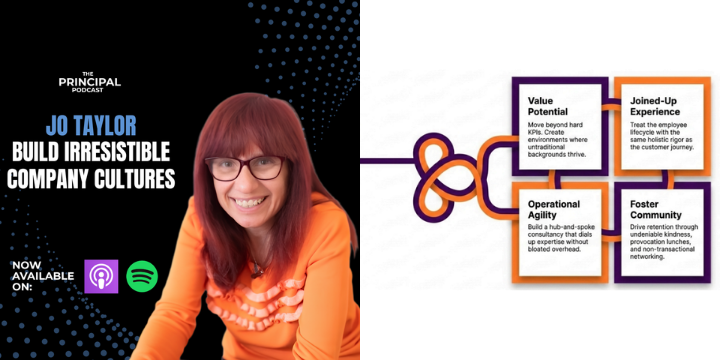
Many organisations still treat people like resources to be managed, not potential to be unlocked. In an episode of The Principal Podcast by GHA Marketing, host Dennis Black speaks with our Managing Director, Jo Taylor, about how evidence-based talent strategy can transform company culture and retention.
Drawing on her experience at the BBC, Channel 4, TalkTalk and global organisations, Jo argues that performance-only thinking is limiting growth. Businesses obsess over productivity and KPIs while overlooking the talent, ambition and individuality already inside their teams.
Read up on Jo’s key lessons and how people leaders can improve company culture and employee experience. Jo covers:
- Why traditional cultures are still broken
- What evidence-based talent strategy looks like
- 1: Everyone has talent – unlock it
- 2: Consistency builds trust in the employee experience
- 3: Retention is about relationships, not perks
- Practical actions for people leaders to build irresistible company cultures
Why traditional cultures are still broken
Jo highlights that many organisations are stuck in an industrial-era mindset: task-focused, efficiency-driven and heavily reliant on performance metrics. Skills, job titles and outputs are prized, while individuality and potential receive far less attention.
People are often placed into boxes based on role, level or demographics. Those assumptions shape who gets opportunities, who is seen as “high potential” and whose voice is heard. Over time, this narrows your talent pipeline and leaves many capable people disengaged.
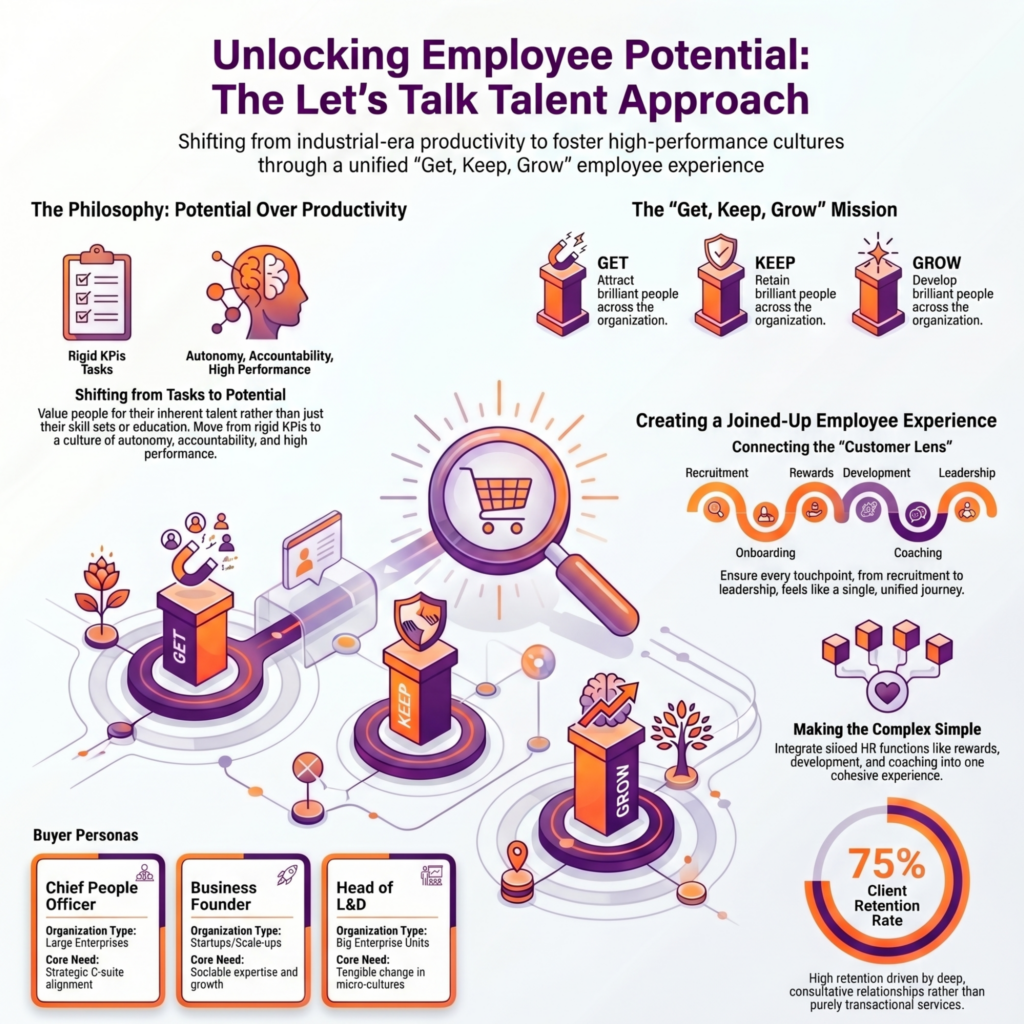
The result is a fragmented employee experience. A glossy careers site gives one impression, interviews another, and onboarding and development something else entirely. When those moments do not connect, employees struggle to trust what the organisation says it stands for.
What evidence-based talent strategy looks like
In contrast, evidence-based talent strategy uses data, feedback and real employee experience to shape how you attract, develop and retain people. It balances two priorities: delivering performance today while nurturing the potential your organisation will need tomorrow.
This approach looks across the whole employee journey:
- What candidates see on your website
- How they are selected and onboarded
- The development, feedback and progression they experience
The question is: do these touchpoints consistently reinforce the culture you want to build?
At Let’s Talk Talent, we help organisations “get, keep and grow brilliant people” by designing people strategies that are coherent, realistic and aligned to the business. If you are beginning that journey, our consultancy services are designed to support this kind of joined-up change.
1: Everyone has talent – unlock it
Jo believes every person has talent and potential, regardless of their background, education or career path. The leadership challenge is to recognise and unlock it, not to filter people out too quickly based on narrow criteria.
That means moving from a mindset of “Who is high potential?” to “What potential does each person have, and how do we help them use it?” In practice, this could involve:
- Broader criteria in talent reviews and succession discussions
- Development pathways tailored to different strengths and ambitions
- Giving people real autonomy and accountability over their careers
When organisations expand their definition of talent, they widen their pipeline and create cultures where more people can thrive.
2: Consistency builds trust in the employee experience
Leaders should view employee experience like customer experience. Candidates and employees now have endless content, tools and providers to choose from. What stands out is not another programme, but a consistent, credible experience.
That consistency needs to run from first contact through to long-term development:
- Careers pages and employer branding should reflect reality, not just aspiration.
- Interviews and onboarding should reinforce your values and expectations.
- Development, performance and leadership behaviour should tell the same story.
If you want to strengthen this journey, Let’s Talk Talent’s learning and development offer focuses on building coherent, experience-led development pathways that support the culture you want.
3: Retention is about relationships, not perks
When it comes to improving company culture, Jo makes it pretty clear that perks alone don’t retain people. Benefits can attract attention, but long-term commitment is driven by the quality of relationships at work. Employees stay where they feel seen, heard and valued.
That shows up in:
- Managers who take development conversations seriously
- Leaders who listen and act on feedback
- Environments where people can show up as themselves
Practical actions for people leaders to build irresistible company cultures
- Audit your employee experience from attraction to progression and identify where the story breaks.
- Challenge narrow definitions of talent and broaden who is considered for key opportunities.
- Align your messaging with reality so that what you promise externally is what people feel internally.
- Invest in manager and leadership capability to build the relationships that underpin retention.
- Use data and feedback to prioritise changes that make the biggest difference to experience and performance.
For examples of how this works in practice, explore Let’s Talk Talent’s case studies.
Making irresistible culture your next business advantage
Irresistible company cultures are not the result of a single initiative or benefit. They are built by consistently applying an evidence-based approach to talent – one that values potential as much as performance and designs experiences that genuinely support people to grow.
To go deeper, explore Let’s Talk Talent’s latest WhatsApp courses, whitepapers and webinar events via their resources. And if you are thinking about your future leadership pipeline, download the succession planning whitepaper to turn today’s potential into tomorrow’s leaders.
To listen to the full conversation, check out The Principal Podcast on Apple Podcasts, Spotify and YouTube.