Some teams just work. They click. They perform. They back each other up naturally and adapt to ever-changing demands. When they leave the office at the end of the day, they feel like they’ve done something meaningful – individually and collectively.
Others just scrape by. Meetings go round in circles, good people leave quietly and managers sit wondering why all the effort never quite hits the ‘team performance’ sweet spot. Sound familiar? You’re not alone.
The gap between these two realities is not closed by finding the right people or waiting for the right moment. We close the gap by deliberately designing our teams and focusing on developing them in a way that sets them up for success in the future. In 2026, the team performance gap is getting harder to close with all the changes to the way that we work.
Employee Engagement Is Dwindling
Global employee engagement sits at around 21%. In the UK it is even lower – hovering at about 10%. This puts us near the bottom of the European rankings.
What is even more alarming is that this has dropped for the second consecutive year, returning to its lowest point since 2020. These are not abstract HR metrics; it is tangible in how teams think, collaborate and perform every single day.
If you are looking for the root cause of underperformance in your business, the answer is almost always visible at team level.
Getting to Grips with Real Team Performance Challenges
So, what are the real challenges and what does great really look like? This article covers the biggest team performance challenges that HR leaders are supporting the business to navigate – from low engagement and fragmented communication to cross-functional failures and retention pressure.
We will also share practical steps you can take to move from ad hoc activities to something data-led and impactful.
- Why Team Performance Has Never Mattered More
- Team Performance Challenges HR Can’t Ignore
- How to Improve Team Performance: What Great Looks Like
- Practical Steps to Improve Team Performance
Why Team Performance Has Never Mattered More
Team performance has never mattered more because right now, business leaders are navigating a perfect storm:
- Low engagement
- Hybrid work fatigue
- Skills shortages
- AI disruption
- Rising expectations around wellbeing and inclusion
These are not separate problems. They collide inside teams every day! They impact how each individual shows up – just ticking boxes or fully committed. Understanding how these elements work together is no longer optional for business leaders. This is the foundation of a credible – and human – team performance strategy.
The business case can’t be a subtle, nice to have. High performing teams drive engagement, productivity, the quality of decision making, innovation, retention, customer experience and employer brand.
Gallup estimates that low engagement costs the global economy approximately USD 8.0 trillion in lost productivity. This is what we lose when your teams are disconnected, unclear about how and why they exist or are poorly led. With only 1 in 5 employees engaged globally and only 1 in 10 in the UK, we cannot rely on exceptional individuals to compensate for underperforming teams indefinitely.
What’s at stake if team performance is neglected?
If we don’t take deliberate actions to address team performance we create unintended consequences:
- Rising burnout and stress particularly in teams carrying unclear expectations alongside heavy workloads. That combination depletes energy and erodes commitment faster than almost anything else
- Inconsistent collaboration between functions which leads to delays, rework, duplicated effort and missed strategic opportunities, especially in organisations running transformation or growth programmes
- Higher voluntary turnover in critical roles, with high performers and high potentials the first to leave environments where their contribution goes unrecognised
- Slower, more risk averse decision making, making organisations less adaptable precisely when markets are most volatile
According to McKinsey when team health improves, the whole organisation benefits. We see this with our clients all the time and it’s exactly why we designed a practical workshop to improve team motivation. Team collaboration and high performance is now a board level agenda item and not just a HR plan.
Team Performance Challenges HR Can’t Ignore
Understanding the real team performance issues that your teams are facing is key to knowing what you can do to tap into the potential of the team. These are team performance challenges that we know are going wrong in 2026.
Employees are not engaged or motivated
Low engagement does not tend to announce itself dramatically. It accumulates in quieter ways – and if you’re nodding along to any of these, you’re not imagining it:
- Inconsistent effort, with some team members giving everything and others doing the minimum
- Minimal peer collaboration beyond what is formally required
- “Just doing the job description” rather than looking for ways to genuinely contribute
- Reluctance to take accountability, especially when things go wrong
- Rising low level conflict or a pervasive sense of apathy
And it doesn’t stop there. Wellbeing compounds all of this. Over half of employees report significant workplace stress, and 42% of HR leaders say wellbeing is a top challenge. Stress doesn’t stay with the individual – it travels through the team, lowering psychological safety and reducing the willingness to speak up, try new things or ask for help.
You are experiencing cross functional team failures
McKinsey research indicates that roughly three in four cross functional teams underperform on key metrics. The culprits are familiar:
- Collaboration breakdowns
- Unclear decision rights
- Competing priorities
- And no shared goals
In 2026 this plays out in transformation programmes that fail to land and teams that create internal friction rather than business value.
The symptoms are easy to spot once you know what to look for – and chances are, you’ve seen at least one of these:
- Multiple stakeholders but no clear owner of outcomes. Responsibility belonging to everyone usually means it belongs to no one.
- Teams measuring success differently, which creates misaligned incentives that pull in opposite directions.
- An escalation culture where everything goes up the hierarchy instead of being resolved at the right level.
- Informal teams forming to work around slow processes, which is a sign that formal structures have stopped serving the work.
Hybrid working has caused fragmented communication
Hybrid or remote environments can deliver real benefits, flexibility, broader talent access, focused work, but they can also fragment what holds teams together. In office staff access informal conversations, context and visibility that remote colleagues routinely miss. Small decisions get made in corridors. Tone gets lost in messages. Context setting that would once have happened naturally just does not happen at all.
Proximity bias makes the problem more complex. Managers unconsciously favour people they see more often, which affects performance ratings, development opportunities and inclusion. That erodes trust and team cohesion in ways that rarely surface in an engagement survey.
The practical consequences of hybrid working are very real – and very costly:
- Decisions made impromptu in office conversations, not captured or shared with the full team
- Remote colleagues feeling like second class participants and gradually disengaging
- Over reliance on meetings and messages instead of clear, documented agreements
- Persistent confusion about “how we work” norms, availability expectations, response times, which channels to use
Increased turnover, high potential exits and retention pressure
Teams with low engagement experience between 18% and 43% higher voluntary turnover. Many industries are seeing rising attrition among high potential employees, the very people who carry business knowledge, mentor others and are most capable of elevating team performance. When they leave, the gap they create is rarely filled quickly or completely. This sets up a damaging cycle.
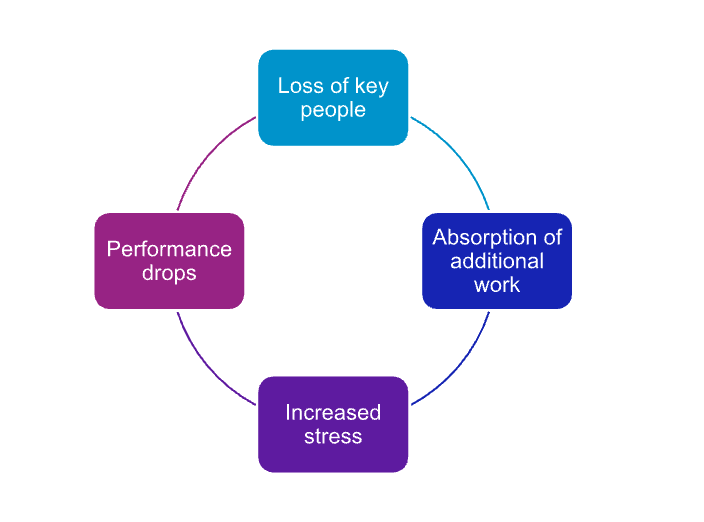
Around 37% of HR leaders highlight retention as a key 2026 priority, with particular concern about losing future leaders and critical specialists. At team level, that cycle looks like this:
- Constant onboarding consuming time and energy that could go towards actual work
- Loss of business knowledge that lives in people’s heads, not in documentation
- More time spent firefighting, managing transitions and covering gaps, than improving the way the team works
HR capacity, strategy and technology gaps
Supporting teams well requires HR capacity and strategic positioning that many organisations do not currently have. Over half of HR teams have not grown headcount despite significantly expanded responsibilities, and some are actively shrinking. The result is a function that is too stretched to support teams deeply and consistently.
Only around 15% of HR leaders are engaged in truly strategic workforce planning, and many are still seen primarily as a cost and compliance function rather than a strategic partner in performance. That limits the impact HR can have on the team level issues that matter most.
Technology is adding another layer too. While 44% of HR leaders plan to deploy AI tools in 2026, only around a quarter of employees currently use AI in their work, compared to approximately 46% of managers. That uneven adoption creates capability and expectation gaps that ripple through how teams operate, learn and make decisions.
How To Improve Team Performance – what great looks like
Think of high performing teams as a well configured WI-FI network.
When everything is working as it should, you barely notice it. Information flows clearly, everyone stays connected and the system handles pressure without dropping out. What does that look like in practice?
- Strong signal strength, where communication is clear, consistent and reaches everyone, not just those closest to the source
- No dead zones, meaning no team members are siloed, overlooked or left out of the loop. Remote and in office colleagues experience the same quality of connection
- High bandwidth, so the team has the capacity and resilience to handle peak workloads without performance degrading under pressure
- Automatic load balancing, where work is shared fairly with tasks matched to strengths rather than defaulting to whoever shouts loudest or sits nearest
When performance suffers, it is often for the same reasons a network drops. Interference from unclear expectations and conflicting priorities.
Outdated infrastructure in skills or processes that have not kept pace with demands. Too many devices competing for the same signal when there are competing agendas and unclear ownership. High performance is not about working harder. It is about being fast, stable and intelligently managed.
The best performing teams start with purpose
The best performing teams do not start with KPIs, they start with purpose. A clear, shared understanding of why their work matters and who it serves. That is what unlocks that extra effort, care and genuine commitment rather than compliance with targets. In an environment where change and ambiguity are constant, purpose becomes the anchor that keeps teams focused and energised even as priorities shift around them.
Clear expectations enhances purpose
But for some, purpose alone is not enough though. One of the most consistent blockers to team performance is vague or inconsistent expectations. When different managers define “great” differently, or when expectations shift without explanation, team members are left guessing what success actually looks like.
This is where competency frameworks become essential. Not as bureaucratic documents but as the golden thread connecting organisational strategy, team expectations and individual development. Future proofing your organisation through competency frameworks means making performance visible, fair and consistently understood across every team.
Find out how we delivered a practical, sequenced roadmap to improve performance expectations across the business.
The STAR model breaks down what teams need
At Let’s Talk Talent, we use the STAR model but in 2026 we have now added a 5th lens as a simple, practical way to understand what teams need to perform at their best – and it’s simpler than it sounds. We’ve updated it to make sure we bring the future into the design of teams:
- Skills, the technical and interpersonal abilities required for the team to deliver its purpose.
- Training, targeted development that closes specific gaps rather than generic courses that fill calendars.
- Attributes, the behaviours and mindsets that support future performance: curiosity, resilience, collaboration, accountability.
- Relationships, how the team works with each other and engages with key stakeholders across the business.
- Intelligence (new for 2026): What AI fluency, data literacy, and critical thinking skills does your workforce need to thrive?
HR and leaders can use the STAR model in a structured way:
- Map current team capability across all four dimensions.
- Identify patterns. For example, strong technical skills but fragile internal relationships. Or good interpersonal dynamics but unclear role expectations.
- Prioritise two or three focused development actions per team rather than trying to fix everything at once.
This shifts team development from instinct led to evidence led and makes it easier to track progress and demonstrate impact over time. Combining the STAR model with a clear view of how you create high performance through L&D gives HR and leaders a coherent toolkit rather than a collection of disconnected interventions.
Download our competency framework whitepaper, covering the STAR model so you can weave this framework through your entire employee experience.
Practical Steps to Improve Team Performance
HR and leaders need quick wins alongside long term change. The good news is that small, consistent actions at team level can move the dial meaningfully, even in a complex, resource constrained landscape. Each of these five actions can be kicked off within a single quarter:
- Run a team purpose session using structured questions and exercises to explore why the team exists, who it serves and what success looks like. Capture the output as a team charter everyone can return to when priorities blur.
- Map your team against a STAR-I style competency view and agree two or three priority development areas for the next quarter. This does not need to be a lengthy process. A focused team conversation with a simple framework is often enough to surface the most important gaps.
- Understand your teams’ members individual and collective strengths and their aspirations – knowing the individual strengths helps you understand the collective strengths of the team so that you make informed decisions when sharing the workload and focussing development. Differentiated support signals that the organisation takes individual growth seriously, which in turn supports retention.
- Audit your hybrid communication behaviours and impact, how decisions are documented, how remote participants are included, which channels serve which purposes. Agree a small number of clear rules that reduce fragmentation and create consistency across locations.
- If you want support to design and run these kinds of interventions, our high performing teams’ workshop give you a structured, facilitated way to build momentum quickly.
Building high performance teams with Let’s Talk Talent
If any of this sounds like your team right now, you’re in the right place. These challenges are real, measurable and pressing – but they’re also very much solvable. With the right combination of insight, practical frameworks and focused support, organisations can shift team performance from a persistent headache into a genuine competitive advantage.
At Let’s Talk Talent, we work with HR Directors, People professionals and senior leaders to design tailored team performance strategies, build the competency frameworks that give teams clarity and direction, and run workshops and programmes that create lasting change. We support organisations at every stage, from initial diagnostics through to embedding the cultures, habits and structures that sustain high performance over time.
Our specific areas of support:
- Team performance consultancy, diagnostics, strategy design and hands on support for teams at every level
- High performing teams’ workshop for leadership teams, cross functional squads, new teams and teams navigating significant change.
- Management and Leadership Workshops to empower managers and leaders to ensure teams understand expectations, development pathways and how success is defined and recognised.
You can also download our Performance Development Whitepaper to explore the frameworks and approaches that help organisations find their sweet spot in improving team performance.
Would you prefer to talk to us?
Please feel free to talk to Let’s Talk Talent about your performance strategy, or how to unlock your teams potential.