A high-performing team consistently delivers more together than its members could alone, and keeps doing so under pressure. What makes the difference is rarely talent. It’s the conditions the team works in: clear priorities, trust that allows honest challenge, strong working relationships and the shared capability to learn and adapt.
The most common pattern LTT sees isn’t a team short on skilled people. It’s skilled people who underperform as a group because nobody has addressed what’s actually getting in the way: unclear priorities, eroded trust or relationships that never moved beyond the transactional. Adding individual training rarely fixes this, because the problem isn’t individual.
This guide walks through the conditions that create high-performing teams, the model LTT uses to diagnose and build them, and seven practical steps you can take this quarter. It’s built around LTT’s Team Performance Triangle, drawing on LTT’s people and team development work.
In this guide:
- What a high-performing team is
- What makes a high-performing team
- What one looks like
- LTT’s high-performing team model
- How to build one, step by step
What Is a High-Performing Team?
A high-performing team is a group of people with complementary skills and a shared purpose who hold each other mutually accountable and consistently deliver results together that none could achieve individually. They sustain that performance under pressure, not just when conditions are easy.
A group of high performers is not automatically a high-performing team. Individual output and collective performance are different things. You can have talented, driven people who compete, duplicate or silo without the deeper coherence that turns a group working alongside each other into a team performing together.
Teams also move through predictable stages before they perform well, from early formation through friction and into effective collaboration. The people and team development page covers those stages and the approaches that support each one.
What Makes a High-Performing Team?
High-performing teams share a small set of conditions: clarity about what matters, psychological safety and trust, strong working relationships, shared accountability and the capability to learn and adapt together.
The characteristics that show up consistently are:
- Clarity of purpose and priorities: everyone understands what the team exists to do and what it’s focused on right now
- Psychological safety and trust: people can speak up, admit mistakes and challenge ideas without fear of embarrassment or reprisal
- Constructive challenge and accountability: disagreement happens in the room, not in the corridor afterwards
- Connection between people: relationships go beyond the transactional, especially under pressure
- Inclusion and diversity of thinking: different perspectives are actively sought and genuinely heard
- Leaders who coach rather than direct: managers develop their people rather than manage their outputs
- Learning and adaptability, including AI: the team builds new skills and adjusts as conditions change
- Sustainable pace and meaningful recognition: performance is recognised specifically and the team can maintain its effort over time
Why Clarity Comes First
The most common blocker LTT encounters isn’t a skills gap or a hybrid working problem. It’s a collapse of clarity.
‘The biggest thing holding teams back right now isn’t skills, hybrid working or budget. It’s a collapse of clarity. People don’t know what matters most, who decides, or what good looks like this quarter. Not because nobody told them. Because they’ve been told too much, too often, by too many people. Clear beats clever. Before you launch your next initiative, ask your managers what they would stop. Their answer will tell you more about performance than any dashboard.’
Jo Taylor, Founder and Managing Director, Let’s Talk Talent
The data supports this. Atlassian’s State of Teams 2025 report, based on a survey of 12,000 knowledge workers and 200 executives, found that only 7% of executives know exactly how their teams’ work supports company goals, and teams spend around a quarter of their working week searching for information rather than acting on it.
A useful starting point: ask each manager in your organisation what they would stop doing this quarter. The answers tend to surface where clarity is missing faster than any engagement survey.
What Does a High-Performing Team Look Like?
A high-performing team isn’t flawless. You can see it in how people disagree, own mistakes, make decisions and look out for each other, especially under pressure.
It’s 8:59am. People are piling into the meeting room, half remote, half in person. Someone’s on mute. Someone’s late. But amidst the chaos, something else is happening: energy, focus and a sense of mutual respect. Someone calls out a win from yesterday; someone else asks for help.
It’s not flawless, it’s functional, human, adaptive and safe.
| High-performing team | Struggling team | |
|---|---|---|
| Priorities | Everyone can name the team’s top three priorities and what has been dropped | Everything is a priority; people work hard on different things |
| Decisions | Clear who decides; decisions stick | Decisions are reopened, escalated or quietly ignored |
| Disagreement | Challenge happens in the meeting, respectfully | Agreement in the room, disagreement afterwards |
| Mistakes | Raised early and treated as learning | Hidden until they become problems |
| Relationships | People know each other beyond the work and ask for help | Conversations are transactional; people work around each other |
| Workload | Pressure is discussed openly before burnout | Overload is worn as a badge or kept quiet |
| Recognition | Specific, frequent, tied to behaviours as well as results | Rare, generic or reserved for a few |
| Hybrid working | Meetings and decisions include everyone, wherever they are | Remote colleagues miss context and influence |
A High-Performing Team Model: LTT’s Team Performance Triangle
LTT’s high-performing team model, the Team Performance Triangle, looks at three things together: culture, chemistry and capability. Teams that struggle are usually strong on one and underdeveloped on another.
The Triangle is introduced here; the full diagnostic is in the Team Performance whitepaper. Download it if you’re planning an intervention or want to see where your team sits across all three dimensions.
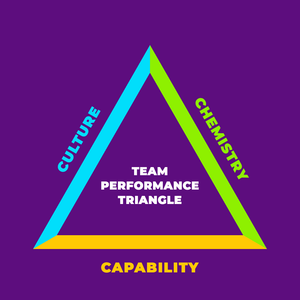
Culture
Culture is the environment the team operates in.
It’s the norms that determine whether people feel safe to speak up, raise a concern, admit a mistake or flag that their workload is unmanageable before it becomes a crisis. Inclusion sits here too, as does accountability without blame.
A 2025 bibliometric review of 278 publications spanning 2018 to 2025 found psychological safety acts as a central linking mechanism across multiple team performance factors. Amy Edmondson defines it as the belief that one won’t be punished or humiliated for speaking up with ideas, questions, concerns or mistakes. That belief, or its absence, shapes almost everything else about how a team functions.
Culture can be actively shaped, and that’s the most important point for any leader reading this. Teams don’t have to accept the culture they’ve inherited. One of the most effective places to start is with emotional culture: not just what the team does together, but how people want to feel working together and whether that matches the day-to-day reality.
Chemistry
Chemistry is the quality of relationships within the team.
It shows up in how a team communicates under pressure, whether people challenge each other constructively and whether they genuinely have each other’s back when something goes wrong. Two people who are nothing alike can have strong working chemistry; two close friends can have poor team chemistry if they can’t disagree productively. Personality compatibility is almost beside the point. What matters is relational trust, built through consistent behaviour and tested through difficulty.
Hybrid working has made chemistry harder to sustain because it removed the informal moments where it used to build naturally. The corridor conversation, the debrief after a difficult meeting, the spontaneous connection that turns a colleague into someone you’d trust with a hard problem: these used to happen because people shared a space and a rhythm. They now have to be designed for, and most organisations haven’t caught up with what that means.
Teams also move through a period of productive friction before real chemistry develops. That stage is uncomfortable, but it’s where genuine trust gets built. Protecting teams from that friction tends to produce surface-level politeness that holds when things are easy and fractures when they aren’t. The people and team development page covers the stages of team development in more detail.
‘Get people to connect more often, and not just about work. When teams are stretched or under pressure to perform, time can be limited and conversations become transactional. Taking a moment to check in on how people are doing, ask about their weekend, celebrate something that’s gone well or have a conversation that isn’t about work can have a big impact on connection and cohesion. Stronger relationships mean better performance.’
Craig Howells, Sales and Operations Director, Let’s Talk Talent
Capability
Capability is the collective ability to perform together.
It covers the collective skills of the team, learning habits, AI fluency and the ability of the team’s managers to coach rather than simply track output. A team’s collective capability isn’t the sum of what its members can do individually. It depends on whether they share a common language for performance and feedback, whether there’s real accountability or just the appearance of it and whether they learn as a unit or as individuals updating their own knowledge in parallel.
Teams that can identify which mode they’re in, learning or performing, and move deliberately between the two tend to outperform those that default permanently to one (Harvard Business Review, 2025). The most common pattern LTT sees is a group of talented people who are capable individually but underperforming as a group, because the shared standards and language aren’t in place rather than because of gaps in any one person’s skills. Our team assessment and coaching work typically starts with exactly that diagnosis.
Why Building High-Performing Teams Is Harder Now
Teams face more competing demands than they did five years ago, and managers are bearing most of the weight.
‘There are so many conflicting priorities for teams, and it affects their performance. For example, managers are told to focus on spending time with their people and supporting them, but also to integrate AI into their workflow while driving bottom-line impact. It’s confusing, and it affects how teams perform.’
Craig Howells, Sales and Operations Director, Let’s Talk Talent
Gallup’s State of the Global Workplace 2026 report found that manager engagement fell five points between 2024 and 2025, from 27% to 22%, the largest annual drop on record, with lower manager engagement accounting for most of the overall decline. In best-practice organisations, 79% of managers were engaged, nearly four times the global average.
The CIPD Good Work Index 2025 adds context: only 60% of managers say they have adequate training to manage staff well and only 59% say they have enough time to do so. The CIPD Good Work Index 2026 makes the stakes clear: employees with the best-rated managers are 89% satisfied with their jobs, compared with 38% of those with the poorest-rated managers (CIPD, 2026). Beyond manager capacity, hybrid working has changed the conditions in which teams operate, AI adoption is adding pressure to learn and adapt quickly and constant organisational change means many teams never fully settle before the next restructure arrives.
Team performance work that ignores the pressure on managers won’t stick. Management and leadership development and leading teams through change are where that support begins.
How to Build a High-Performing Team in 7 Steps
Building a high-performing team starts with diagnosis, not activity: understand what’s actually holding the team back, fix clarity and trust first, then build the habits that keep performance going.
1. Diagnose Before You Intervene
Start with interviews, a team assessment, 360 feedback and some baseline measures before deciding what to do. Stated problems, such as ‘communication issues’, often conceal the real ones: unclear goals, broken trust or an unresolved decision-rights problem.
Our performance management health check template is a useful starting point for this kind of diagnosis.
In practice: run five to eight structured interviews across the team before any workshop or programme. Ask people what they’d stop, change or clarify. The patterns will tell you where to focus.
2. Agree What Matters Most, and What Stops
Co-create three to five priorities with the team, agree the success measures for each and, critically, agree what the team will stop doing to make room for them. The question Jo poses to individual managers applies at team level too: what would you stop?
Anchor these priorities to the wider people strategy so they connect to what the business actually needs.
In practice: hold a 90-minute session where the team maps current commitments against agreed priorities, then explicitly names what gets dropped or paused.
3. Make Roles and Decision Rights Explicit
Agree who decides what, who needs to be consulted and how conflicting priorities get resolved. Most teams have never had this conversation directly, which is why the same decisions get reopened or escalated repeatedly.
In practice: build a one-page decision map covering the team’s five most common decisions: who owns each one, who is consulted and what happens when there’s disagreement.
4. Build Trust and Connection on Purpose
Chemistry doesn’t build itself in a hybrid team. Non-work check-ins, team charters, celebrating wins and time away from the day-to-day all contribute, but they need a clear purpose to be worth the time they take.
See our guide on how to run a team away day that changes how people work for the practical detail.
In practice: add a five-minute non-work check-in to one regular team meeting a fortnight. The return in connection and cohesion tends to be disproportionate to the time it takes.
5. Make Feedback and Accountability Routine
Feedback should be part of how the team operates week to week, not something reserved for formal reviews. Peer accountability, where people hold each other to the standards the team has agreed, is what sustains performance between manager-led conversations.
See our performance management work and the performance and development whitepaper for practical frameworks.
In practice: introduce a monthly ‘what went well and what would we do differently’ reflection into team meetings, keeping it forward-looking rather than evaluative.
6. Equip Managers to Coach
The CIPD found only 59% of managers say they have enough time to manage their people well. Protecting that time, and making sure it’s used for coaching rather than task management, is one of the highest-leverage changes a team can make.
Our high-performance culture workshop gives managers practical tools for shifting from directive to developmental.
In practice: audit how your managers currently spend one-to-one time. If it’s mostly task updates, that’s the first thing to change.
7. Measure, Review and Protect Performance
Use pulse surveys, psychological safety measures, retention data and delivery speed to track whether the team is improving and to catch signs of drift early. High-performing teams need protecting from complacency as much as from underperformance and from overload as much as from disengagement.
In practice: run a short psychological safety pulse every quarter alongside your existing performance data, and review both in the same conversation.
Case Study: Building High-Performing Teams Across Leadership Layers
Challenge
A global sport governing body had 45 senior leaders and managers who were capable individually but underperforming as a group. There were no shared standards, no common leadership language and no collective accountability. The gap between the senior leadership team and the management group meant cultural change couldn’t cascade downwards.
Approach
LTT ran a two-year, three-phase partnership. Year one focused on the Senior Leadership Team, building capability in communication, feedback, coaching and emotional culture. Year two extended the same standards and language to the management group, creating consistency across both layers and enabling managers to challenge senior leaders more constructively.
Results
Difficult conversations became the norm. Managers held senior leaders to account more constructively, the CEO’s direct reports noted he was more willing to tackle hard conversations and staff could feel the difference in how leadership was communicating.
Looked at through LTT’s Team Performance Triangle: the work built shared language and standards (culture), created the conditions for constructive challenge (chemistry) and developed the feedback and coaching skills the organisation needed (capability).
When to Bring in a High-Performing Teams Consultancy
Outside support helps most when a team keeps hitting the same problem, when a leadership team is misaligned or when internal HR is too close to the issue to diagnose it objectively.
Signs it’s time to bring in external support:
- the team has been through a merger, acquisition or restructure and hasn’t settled into a coherent way of working
- a new leadership team is in place but hasn’t gelled around shared standards or accountability
- the same initiatives keep failing or stalling without a clear reason why
- HR or OD teams are too close to the politics to diagnose the root cause objectively
Good external support starts with diagnosis rather than a predetermined programme. It’s designed around the team’s real work and establishes baseline measures so there’s a clear picture of what’s changed. Our high-performing teams consultancy follows this approach, and you can see how it’s worked across different organisations in our client case studies.
Build a Team That Performs Together
Capability is rarely the constraint. Clarity, chemistry and culture are where performance is won or lost, and they’re what most organisations underinvest in because they’re harder to measure than skills.
If your team has the talent but isn’t performing the way you’d expect, the answer is usually in one of the three corners of LTT’s Team Performance Triangle. Talk to us about building a high-performing team and we’ll help you work out which one.
FAQs About High-Performing Teams
What is a high-performing team?
A high-performing team is a group of people who consistently deliver more together than they could individually and sustain those results under pressure. They share clear priorities, trust each other enough to challenge and admit mistakes, hold each other to account and keep learning as conditions change. For more on everyone’s role in high-performing teams, see our companion guide structured by team member, manager and organisational responsibility.
What are the characteristics of a high-performing team?
The main characteristics are clarity about priorities, psychological safety and trust, constructive challenge, strong working relationships, shared accountability, inclusive decision-making, leaders who coach, continuous learning and a sustainable pace. LTT groups these into three areas through the Team Performance Triangle: culture, chemistry and capability.
What is a high-performing team model?
A high-performing team model is a framework for diagnosing and improving how a team works. LTT’s Team Performance Triangle looks at culture, chemistry and capability together, because teams rarely underperform for lack of skills alone. Weakness in any one of the three tends to undermine the others.
How long does it take to build a high-performing team?
It depends on where the team starts and what’s holding it back. Focused interventions can shift behaviours within 6 to 12 weeks, but lasting change across leadership layers often takes a year or more. LTT’s work with a global sport governing body ran over two years in three phases.
Why is psychological safety important for high-performing teams?
Psychological safety means people believe they can speak up, ask questions or admit mistakes without being punished or embarrassed. Without it, problems surface late, ideas go unshared and disagreement goes underground. A 2025 bibliometric review of 278 publications identifies it as a central linking mechanism across multiple team performance factors.
How does hybrid working affect team performance?
Hybrid working removes many of the informal moments where trust and relationships used to build, so high-performing hybrid teams create them deliberately. They agree how decisions are made and shared, make sure remote colleagues have equal influence and set aside time for conversations that aren’t about tasks. Our guide on everyone’s role in high-performing teams covers the hybrid dimension in more detail.