Many organisations adopt OKRs hoping for the clarity and focus that Google is famous for, then find that a year in, nothing much has changed beyond more acronyms and admin. The goals are set and the spreadsheet is updated but performance feels exactly the same.
If that sounds familiar, this article will help you diagnose why your OKRs aren’t landing, work out what to fix or stop, and explore a performance development approach that actually fits your context.
In this article you’ll learn:
- What OKRs are and what problem they’re designed to solve
- Why OKRs can work and be powerful when conditions are right
- The most common reasons OKRs fail
- What needs to be in place before OKRs can work
- What to do next if you’re ready to reset
What Are OKRs and What Do They Solve?
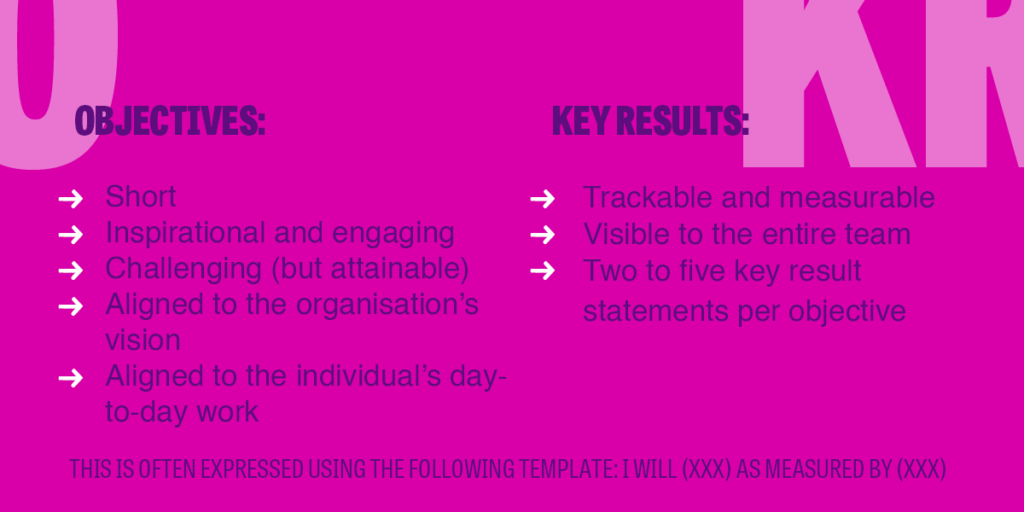
OKRs are a goal-setting framework that aligns stretching objectives and measurable key results across organisation, team and individual levels. The objective sets direction, while key results define what success looks like. Together they create focus, drive pace and give people a clear line of sight between their daily work and the organisation’s priorities.
At LTT, we think about this as performance development rather than performance management. OKRs can be a useful part of that, but they’re one tool within a broader approach.
What’s the Difference Between OKRs and KPIs?
- OKRs are for focus and change: stretching, time-bound and tied to strategic priorities
- KPIs measure health: tracking whether the business is running as it should, steady-state not stretch
- Confusing the two, or replacing KPIs with OKRs across the board, is one of the most common performance management design mistakes
What’s Good About OKRs When They Work?
When OKRs are aligned, focused and well-supported, the evidence is strong: 83% of companies using OKRs report a positive impact. The three main benefits when implementation is done well are:
- Clarity and engagement: people know what matters and how their work contributes
- Focus and performance: fewer priorities, properly aligned, create more impact than competing objectives spread across teams
- Better conversations: consistent check-ins create a natural rhythm for coaching and course-correction, not just status updates
Why Do OKRs Fail?
Most OKR failures aren’t about the framework. They’re about context, design and behaviour. Around 70% of companies abandon their goal-setting systems within three years. Here’s what drives that.
There’s No Clear Strategy for OKRs to Hang Off
OKRs are only as strong as the strategy they’re connected to. Without a small set of clear shared priorities, teams write goals in isolation that don’t add up to anything meaningful. The result is conflicting objectives, lots of activity and limited impact on what actually matters.
A 2025 OKR Benchmark Report found that 65% of startups fail to connect OKRs clearly to company-level goals. That gap doesn’t just undermine focus, it damages trust in the process.
You’ve Set Too Many OKRs and They’re Too Complex
When every team has six objectives and each has five key results, the framework collapses. OKR lists start looking like project plans, attention gets diluted and confusion about priorities sets in. High-performing organisations limit OKRs to three to five objectives maximum, treating them as a focus tool not a task list. If you can’t choose what’s on the list, the problem isn’t the format, it’s that no one has made the strategic call on what matters most.
You Treat OKRs as a Quarterly Form, Not an Ongoing Conversation
For OKRs to fail, set and forget is the most common failure pattern. OKRs are written at the start of the quarter, filed somewhere and only revisited when it’s time for the next cycle. Check-ins don’t happen, or they’re purely status-based with no real coaching conversation attached.
Successful companies have 28% higher communication intensity, with more frequent check-ins consistently correlating with better outcomes.
Leaders Lack the Skills and Time to Coach Around OKRs
Analysis consistently identifies poor leadership habits as a top barrier to OKR success. When leaders disengage after the launch, the message is clear: this isn’t a real priority. Managers unclear on how to set stretching but realistic goals, with little time to coach and no accountability for making it work, turn OKRs into a paper exercise fast.
Performance development relies on manager capability, not just a framework. The best-designed OKR system will underperform if the people running it haven’t been equipped to use it.
Your Culture Doesn’t Support Honest Goals or Learning
OKRs ask people to set ambitious goals and be transparent about progress. In organisations where honesty carries risk, that’s a big ask. Fear of failure produces sandbagged objectives, and blame cultures turn missed key results into a threat rather than a learning moment. Without psychological safety, the transparency the framework depends on simply won’t happen.
You’re Using OKRs as Performance Ratings, Not a Learning Tool
Tightly linking OKRs to pay and bonuses is one of the most cited reasons programmes stall. When people know their OKR score affects their compensation, they stop setting stretching goals and start setting safe ones. You get conservative targets, gaming of measures and a focus on hitting numbers rather than learning or creating value. OKRs and reward decisions need to stay separate.
What Needs to Be in Place Before OKRs Will Work?
A Clear Organisational Strategy and Direction
For OKRs to work, teams require a small set of well-understood strategic priorities they can translate into meaningful outcomes. Without that, alignment is impossible regardless of how well the framework is designed.
A Culture of Continuous, Two-Way Feedback
Regular check-ins and retrospectives baked into the operational rhythm, with space to adapt OKRs when strategy or circumstances shift. Feedback needs to flow both ways.
A Capable, Confident Management Community
OKRs work when managers are trained in setting stretching objectives and coaching people through them, not just tracking progress in a tool. Our performance management consultancy helps build both the framework and the capability to make it work.
Time and Capacity to Manage the Process
OKRs require more ongoing investment than a traditional annual appraisal cycle. Rushing implementation without realistic time for alignment and check-ins generates cynicism.
A Culture of Trust and Psychological Safety
People need to feel safe to be honest about blockers and missed progress, and to reset OKRs when needed. Our team performance consultancy helps teams build the trust that makes this possible.
What to Do Next if OKRs Aren’t Working
If OKRs aren’t working, it’s common for struggles to be felt — but it’s fixable. Here’s a simple recovery plan:
- Diagnose what’s really going wrong: use the failure patterns above as a checklist and prioritise the one or two with the biggest impact.
- Simplify and re-align: if they’re not working, cut the number of OKRs, clarify the strategic link and remove anything that’s a task list in disguise.
- Strengthen leadership and feedback habits: invest in manager capability, build a consistent check-in cadence and make OKRs a live part of how teams operate.
- Separate OKRs from pay: decouple them from compensation and add growth goals as a separate development track.
- Consider alternatives if OKRs aren’t working: growth goals, team performance agreements and clear role expectations linked to regular coaching can deliver similar benefits with less structural demand.
Revamping Your Performance Management Process Beyond OKRs
OKRs are one tool, not the whole system. At LTT, we focus on finding the right balance between people, managers and processes for each organisation’s context. That means:
- Clear role and team expectations linked to strategy before any goal framework is layered on top
- Regular coaching-based performance conversations rather than form-filling
- Growth goals sitting alongside objectives so career growth and performance management are part of the same conversation
- Simple, transparent frameworks that managers can actually use
Download the performance development whitepaper for practical frameworks, or build the skills in our performance management for managers workshop or Performance Management 101.
How to Make Goals Work for Your Team – Whether You Use OKRs or Not
OKRs can be useful, but only when supported by clear strategy, a feedback culture and managers who know how to coach. Without those conditions, redesigning your performance approach will serve you better than forcing a framework that isn’t working.
To make goals work for your team, review your current setup using the questions in this article. If gaps are showing up, we’re here to help you work through them. Talk to us about managing team performance or get in touch directly to start the conversation.
FAQs About OKRs and Performance Management
What are OKRs, in simple terms?
OKRs are a goal-setting framework, pairing a stretching objective with measurable key results that define success. They’re designed to create focus and alignment at organisation, team and individual level.
Why are OKRs not working in my business?
OKRs do not work for businesses often because of one of five things: no clear strategy to anchor them to, too many goals, a ‘set and forget’ approach, managers not equipped to coach around them, or a culture where honest progress conversations don’t happen. The failure patterns above are a useful checklist.
Should OKRs be linked to pay and bonus?
No, OKRs should not be linked to pay and bonus. Tying OKRs to compensation leads to conservative goal-setting and gaming of measures. Keep them as a development and focus tool, separate from reward.
How many OKRs should we set per team or person?
When setting OKRs per team or person, set around three to five objectives, each with three to five key results. The purpose is focus. More than that and you’ve built a priority list, not a goal framework.
How often should we review OKRs?
OKRs should be reviewed during weekly check-ins and end-of-cycle retrospectives. Teams with this cadence complete significantly more OKRs than those reviewing less frequently.
What are the alternatives if OKRs just aren’t a fit?
If OKRs aren’t a fit, focus on growth goals, team performance agreements and clear role expectations linked to regular coaching conversations. Our fresh take on growth goals is a practical starting point.